
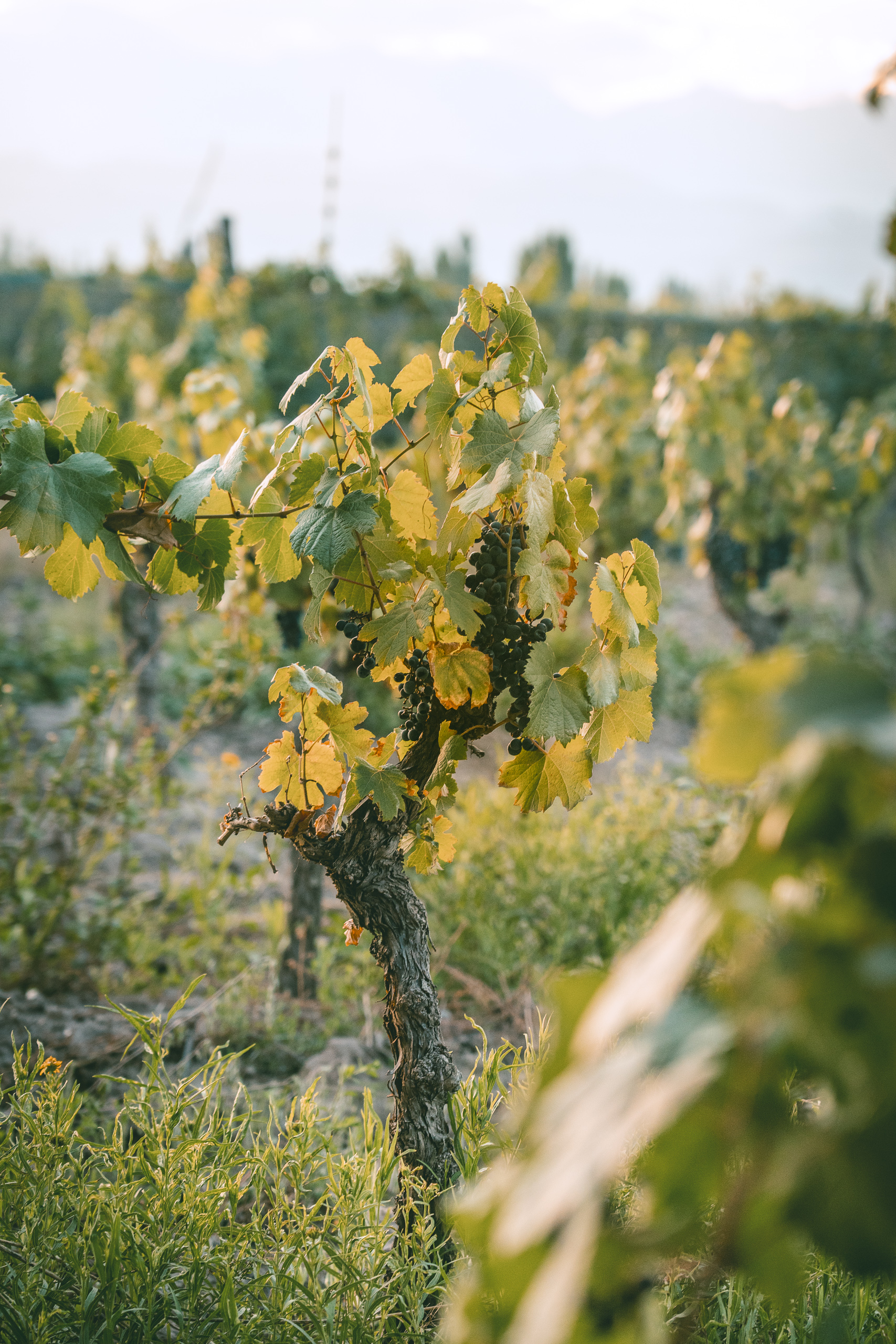

Almost every vine you have ever seen is two plants joined at the hip. Ours are not, and understanding why took me longer than buying the vineyard did.
In the second half of the nineteenth century an aphid arrived in Europe on imported American vines. Phylloxera feeds on roots, and European Vitis vinifera (the species behind Malbec, Sémillon, Merlot, Pinot Noir, Riesling, everything in a European wine list) has no defence against it. Within about thirty years it had destroyed a large part of the vineyards of France, then Italy, Spain and Portugal. The eventual answer was surgical: graft a vinifera cutting onto the root system of an American species that had evolved alongside the insect, such as Vitis rupestris. That is what nearly all of the wine world plants today. Above ground it is Malbec; below ground it is something else entirely.
Mendoza is one of the places where that surgery mostly never happened. Phylloxera has been recorded in Argentina, and it exists here; this is not an insect-free paradise, and I am wary of the way that story sometimes gets told. What did not happen is the collapse. Vineyards planted on their own roots kept producing, growers kept planting them, and a great deal of Luján de Cuyo is still ungrafted today.
The explanations usually offered are the sandy, free-draining alluvial soils, which suit the insect far less than heavier ground; the traditional flood irrigation, which periodically saturates the root zone; the extreme dryness of a desert climate with the water arriving from Andean snowmelt rather than rain; and the sheer isolation of the region when European vineyards were being replanted. I find all of that plausible. I would also say plainly that the relative weight of those factors is not settled, and anyone who tells you exactly why Mendoza escaped is telling you more than the evidence supports.
What is documented, and what is not
Our own vineyard was planted in 1920. That date is documented, and the parcel is listed in the Old Vine Registry, the international database that exists precisely because old plantings tend to disappear before anyone records them. The vines are ungrafted, they are more than a century into their working life, and they have never been pulled out and replaced.
What ungrafted roots do to the wine in the glass is a genuinely open question, and I would rather be useful than emphatic about it. Growers who work with own-rooted vines commonly describe deeper root systems, steadier behaviour in hot years, and a certain evenness of ripening. Some researchers report rootstock effects on vigour and water use; others find the site and the age of the plant explain far more than the rootstock question does. I have not run a controlled trial and I am not going to pretend otherwise. What I can say is what the vineyard does: it carries a small crop without being asked to, it ripens at moderate sugar, and it holds acidity into late March in a region where that is not guaranteed.
The age is probably doing more of that work than the roots are. A hundred-year-old vine has an enormous permanent structure and a root system that has had a century to find water; it is a slow, self-regulating machine that does not lurch from vintage to vintage. Whether the absence of a graft union adds to that, I honestly do not know.
A grafted vineyard can be replaced. This one can only be kept.
The part that actually changes decisions
Here is where the ungrafted question stops being academic. A modern grafted vineyard is, in a commercial sense, renewable. If a block underperforms you take it out, order certified plant material of a clone you have chosen, and in four or five years you have a new vineyard. That option does not exist here. There is no nursery selling hundred-year-old ungrafted Malbec from this parcel, and the genetic material in these plants is the accumulated result of a century of this specific site.
So when a vine dies, we replace it with a cutting taken from the vineyard itself rather than a bought plant. It is slower, the success rate is worse, and the resulting vineyard stays genetically messy in a way a nursery order never would. That messiness is the asset. Take an example from football: a team of eleven Messis will not win the World Cup, but a team with Messi, a good goalkeeper, a solid defence and a well-functioning midfield will. A vineyard works the same way: what carries it through a difficult year is the range of plants in it, not one perfect plant repeated ten thousand times. It is also why we did not remove a single plant when we took the estate on, although younger vines would unquestionably give us more fruit per hectare.
The people who farmed this land before us sold the grapes and never made a wine of their own from them, which means that for most of its life nobody was making claims about this vineyard at all. It simply kept going. That is the part I find most persuasive, and the part hardest to put on a back label: a plant that has been productive on this exact spot for over a century has already answered the only question that matters about whether a vineyard belongs here.