
The vineyard had been neglected for years when we took it on. Most of the work since has been subtraction: taking away things that had been added to it.
The family who owned this land before us sold their grapes and never made wine from them. That is an ordinary story in Mendoza, and it has an ordinary consequence: when the fruit leaves by the tonne, nothing in the system rewards you for the quality of a single vine. The plants had been kept alive rather than looked after. Rows were thin where dead vines had never been replaced, the irrigation channels had silted up and no longer delivered water evenly, and at some point someone had run wire and posts through a vineyard that had been planted as free-standing bush vines.
The first decision was the easiest to state and the most expensive to keep: we would not pull anything out. Replanting is the obvious commercial move. Young vines on modern spacing would give us appreciably more fruit per hectare, they would be easier to work, and we could choose exactly what went in the ground. We have not removed a single plant. Where a vine has died we take a cutting from within the vineyard and put that in its place, which is slower and fails more often than buying nursery plants, and keeps the parcel's own genetics in the parcel.
The fact that this vineyard has been alive for more than a hundred years is the argument. It tells you this is the right place for a vineyard.
Taking the trellis off
We did this in one parcel only: the block that now goes into the Malbec Gran Ciclo. There we removed the posts, the wire and the training sticks, and let the vines stand as what they are: old bush vines, each one a self-supporting trunk carrying its own canopy. A century-old plant does not need a trellis. It has built its own structure, and the wire was there because a previous manager wanted uniform rows for machinery, not because the vine asked for it.
Free-standing vines shade their own fruit, which in a place with this much sun is protection rather than a problem, and each plant is worked as an individual. The trade-off is real: everything is done by hand, nothing about the parcel is efficient, and the crop is small. That parcel is also the source of the wine that scored highest of anything we have made, which is not proof of causation, but it is not an argument against the decision either.
The rest of the vineyard stays on its trellis, and it stays under hail netting. Hail is the real risk in Mendoza: a storm in January can take a whole harvest in twenty minutes, and netting needs wire and posts to hang from. Those parcels also feed the wines we have to be able to produce every year. Going free-standing there would mean less fruit and no protection at once, which is a gamble we are willing to take on one small block and not on the vineyard as a whole.
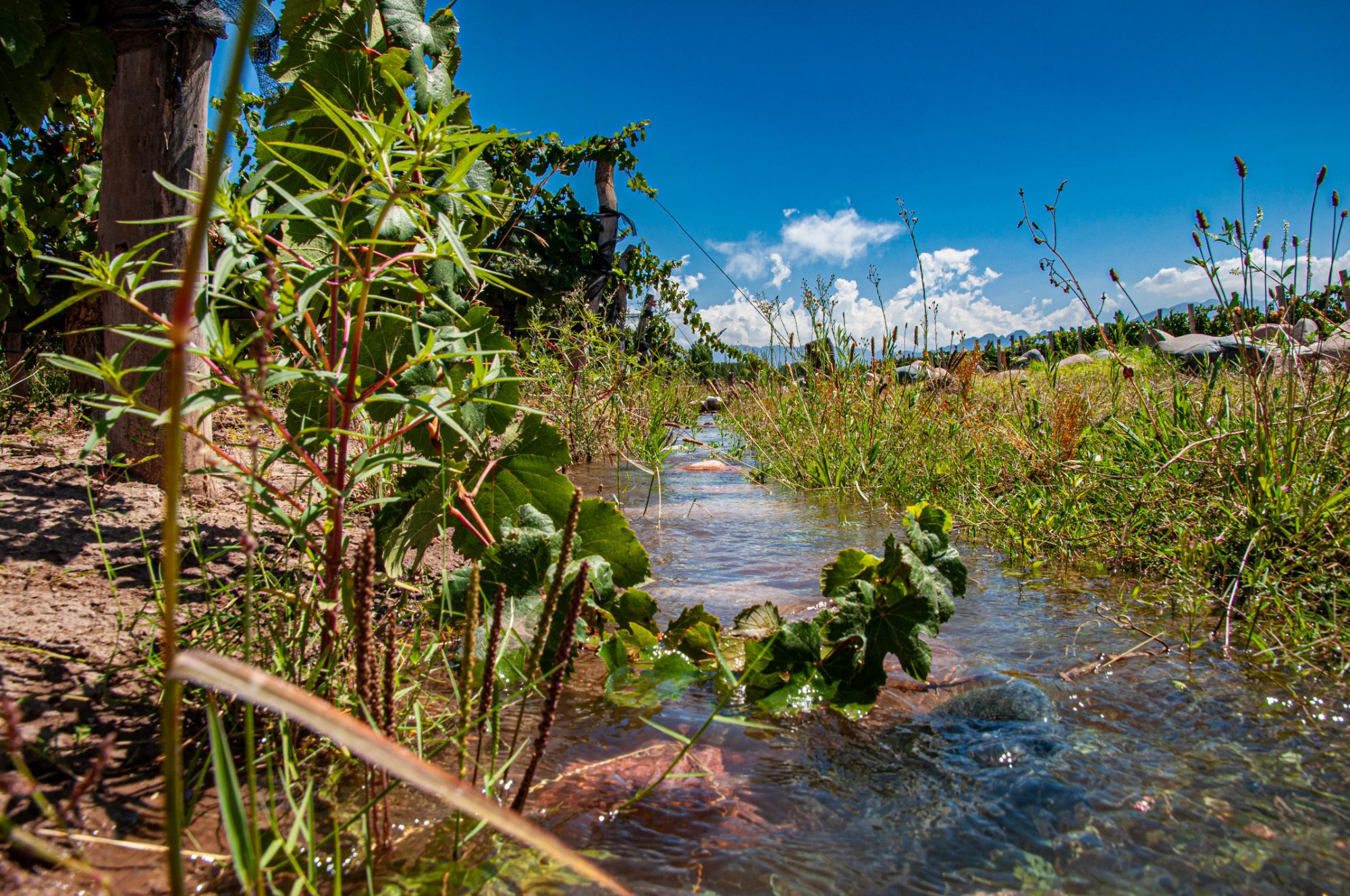
Water back in its channels
We rebuilt the flood irrigation network: clearing the silt, re-cutting the channels, re-levelling so that water reaches the end of a row at the same time it reaches the start. Flood irrigation has a poor modern reputation next to drip, and for a young vineyard on a slope that reputation is deserved. For a hundred-year-old vineyard with deep roots on sand over stone, it is the system these vines have been drinking from since 1920, and periodic deep saturation is part of what they are adapted to. Rebuilding it was less an act of nostalgia than of not interfering.
Between the rows we grow cover crops instead of keeping bare, sprayed ground. They hold the sandy soil in place, feed something other than vines, and bring insects back into a monoculture. There are bees in the vineyard now, which is a poor scientific metric and a good daily one.
Organically, and without a certificate
We farm organically, with some biodynamic practice, and we do not need a certificate for it. No herbicides, no systemic treatments, no soluble fertiliser. We do not work this way in order to earn a logo; we work this way because we are convinced it is the right way to treat this place, and treating nature with respect is not something we would do differently if nobody were checking. The dry climate makes it considerably easier here than it would be in a wetter region, so the credit belongs partly to Mendoza.
What all of this adds up to is not a philosophy so much as a time horizon. The vineyard was productive for a century before we arrived, under people whose names are not on any bottle. The only sensible ambition is that it is still producing in another hundred years, and that whoever is looking after it then has as much to work with as we were handed.