
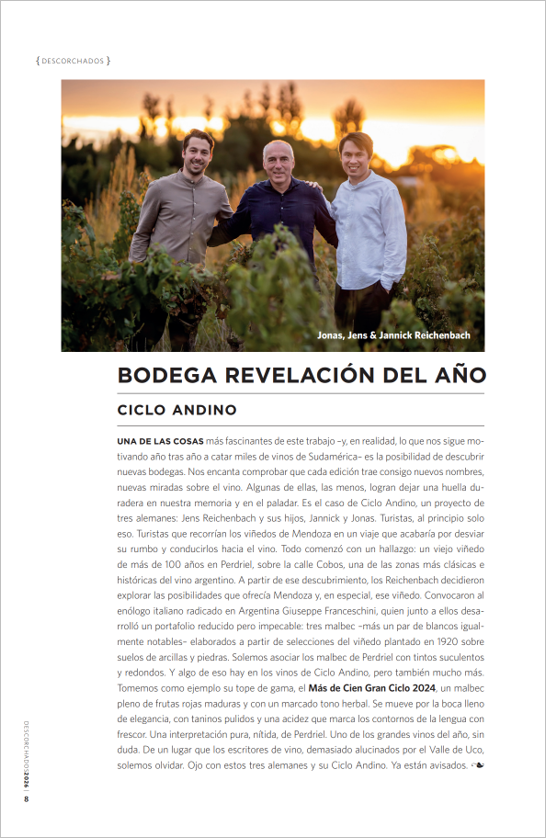
Descorchados named us Winery Revelation of the Year in its 2026 edition. Since I am the one who has to explain what that means to customers, it seems worth writing down properly.
Outside South America, Descorchados needs introducing. It is the annual guide founded by the Chilean critic Patricio Tapia, and across Chile, Argentina, Uruguay and Brazil it is the reference that matters most: the guide that regional trade, restaurants and importers actually work from, in the way that particular European and American critics function in their own markets. Coverage is broad and it is revisited every year, so a producer's entry is not a one-time verdict but a rolling assessment.
Our seven wines scored between 92 and 98 points. The Malbec Gran Ciclo took the 98 and was named the best wine of Perdriel. On the white side, the Reserva Sémillon and the Reserva Malbec both landed at 95, and the Sémillon was placed among the top Sémillons in Argentina, with the Reserva Torrontés in the leading group for its variety. I will let those numbers sit without decoration; anyone who wants the detail can find it in the guide.
Why the Revelation category is an interesting one
A high score on a single wine is achievable in a way that people in the trade understand well. Concentrate the best barrels, make a few hundred cases, and a small producer can compete with anyone. It is a legitimate exercise and it says relatively little about a winery.
The Revelation distinction works differently, because it is not given to a wine. It is given to a producer, on the evidence of the whole range tasted together, which means the entry-level red is as exposed as the flagship. That is the part I find genuinely useful as a piece of feedback. It says the cheapest bottle we make is not a compromise, and for a young estate with three lines that is the only claim worth having. It is also, in the plainest terms, a category you cannot apply for.
What it changed in practice was attention. Importers who had not returned an email answered within a week; sommeliers in Buenos Aires and Mendoza started asking about wines they had not previously heard of; the lodges filled with people who had read about the vineyard before they came. For an estate this size, that is the whole function of a guide entry.
What it does not mean
Scores are one taster's account of a wine on one day, and the honest position on a vintage this young is that we do not yet know how these bottles age. We have made wine here for a handful of harvests. The vineyard has been working for over a century, and any credit for what is in the glass belongs mostly to it, and partly to the people who kept it alive long before anyone was scoring anything.
It also changes nothing about the farming, which is the part I would defend if the next guide is less generous. The medals are on the wall by the tasting room. The vines have not read them.